Why a Fisheye Image Is Curved, and How Calibration Fixes It
In my last post I wrote that the first thing I checked in SfM was the lens model. This post explains why that check comes first.
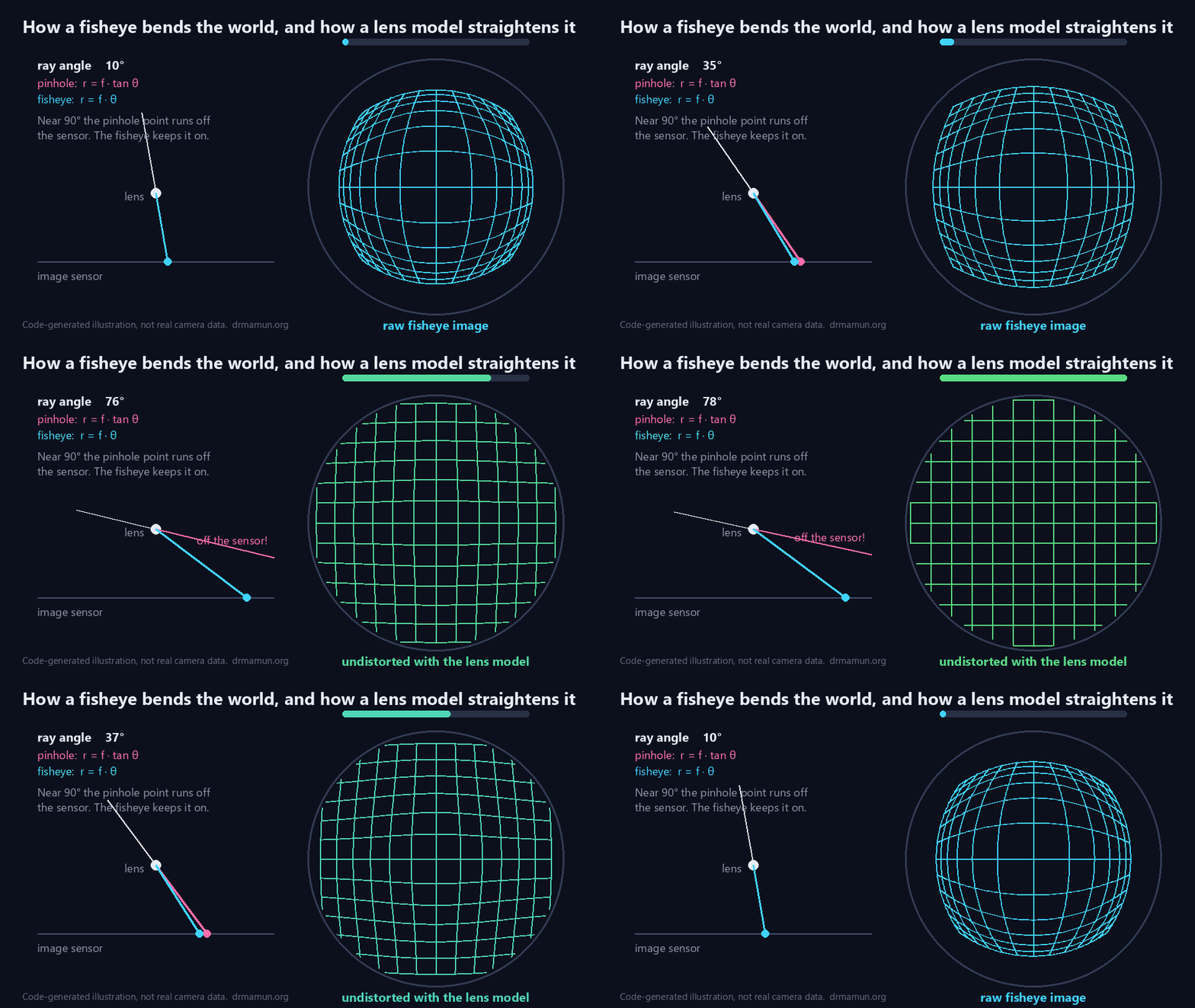
A normal camera works roughly like a pinhole. A ray that enters at angle θ hits the sensor at a distance f·tan θ from the centre. This is fine for a narrow view, but tan θ becomes very large as θ gets close to 90°, so rays from the side would fall outside the sensor. A fisheye lens bends these rays inward, and the distance grows more like f·θ. This lets one camera cover a very wide view, and it is also why straight lines look curved in a fisheye image.
The curve follows a fixed mathematical rule. If we know the rule, we can trace every pixel back to the direction it came from and make the lines straight again. Calibration gives us that rule. If the lens model is wrong, every ray is a little wrong, and the error spreads into the whole 3D reconstruction. So before looking at anything else, I check the lens model.

التعليقات · 1