From a Pinhole Camera to NeRF: The Whole Series in One 8-Minute Video
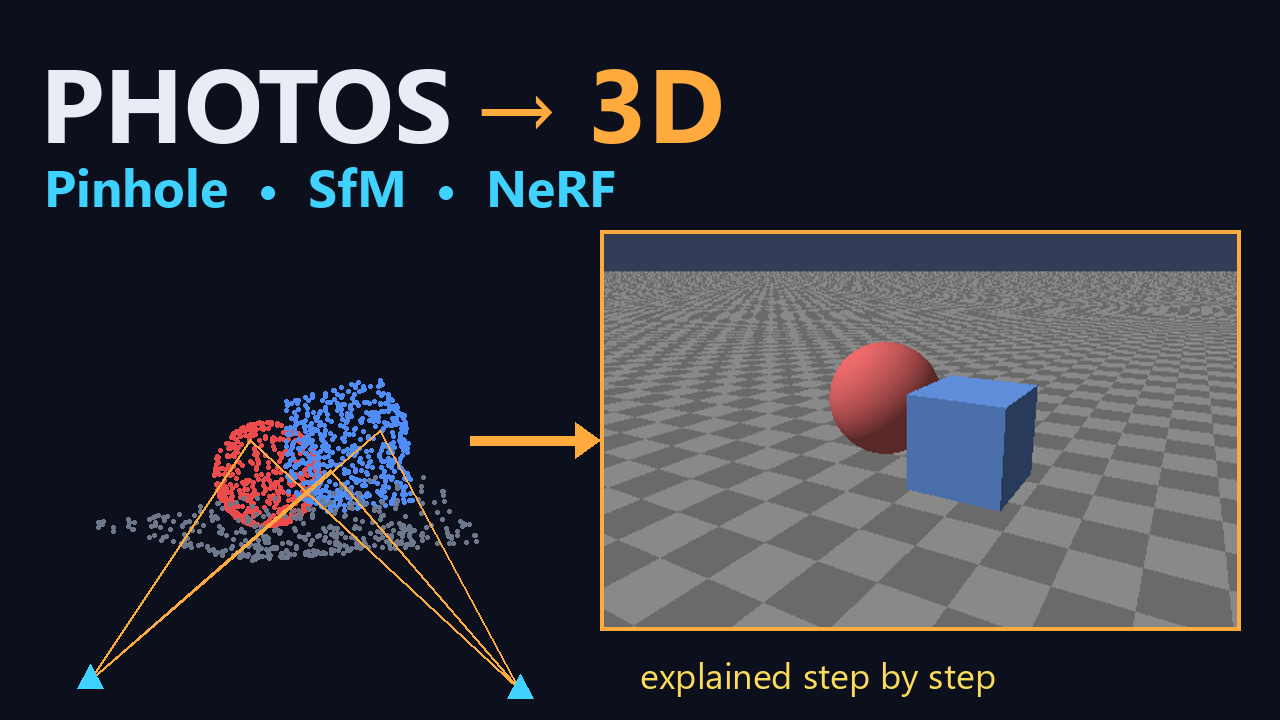
Over the last week I wrote about how computers turn ordinary photos into 3D: the pinhole camera, calibration, Structure from Motion, SLAM and NeRF. I have now put the whole path into one video.
The video goes step by step:
- The pinhole camera, and why one photo loses depth
- The camera matrix K and lens distortion
- Calibration: finding K from a checkerboard
- Feature matching, RANSAC and the epipolar line
- Triangulation and bundle adjustment
- Why Structure from Motion cannot know the true scale
- NeRF: a colour and density field, volume rendering and training
- Faster methods: Instant-NGP and 3D Gaussian Splatting
All the animations are made with code. Most scenes run real calculations on small simulated data: the calibration fit, RANSAC, the epipolar lines, volume rendering, and a small 2D NeRF trained on a normal CPU. The bundle adjustment scene is only an illustration.
For the details behind each step, here are the written posts:
- Structure from Motion: photos to 3D
- The Night the Cameras Taught Me Geometry
- Why a Fisheye Image Is Curved, and How Calibration Fixes It
- How Camera Calibration Finds the Lens Numbers
- Structure from Motion by Factorization
- Can We Build 3D Live? From Structure from Motion to SLAM
- Four Cameras, 360 Degrees: Can a Car Build a Live 3D Map?
- NeRF: How AI Makes a New Photo From a Place Nobody Stood

Comments · 1